· 6 min read
How to train with your cycle: a phase-by-phase workout plan
Your energy isn't the same every week — so your training plan doesn't have to be either. Here's how to match workouts to each phase.
Why your energy shifts
Across a typical cycle, estrogen and progesterone rise and fall in a predictable pattern. Many people notice that strength, stamina and motivation follow along — feeling flat during their period, powerful around ovulation and more easily tired before the next bleed.
Research on cycle-based training is still growing, and everyone responds differently. Think of this as a framework to experiment with, not a rulebook.
Menstrual phase (days 1–5): restore
Choose gentle movement that eases cramps and lifts mood: walking, yoga, mobility work or light swimming. If you feel good, normal training is completely fine — listen to your body, not the calendar.
Follicular phase (days 6–13): build
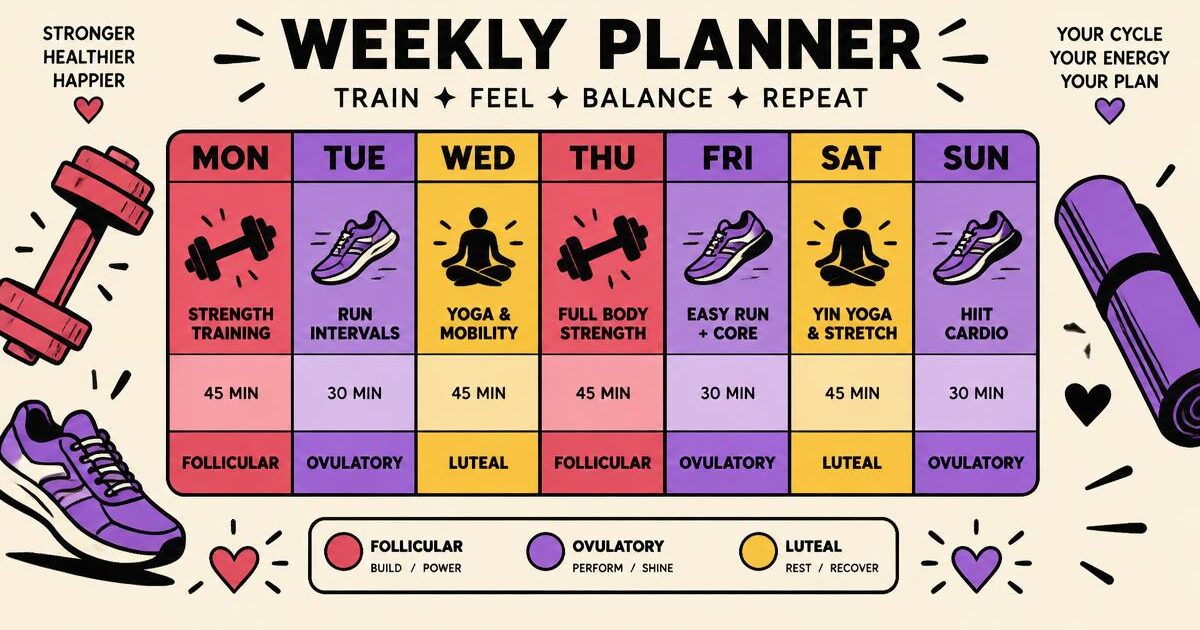
Rising estrogen often brings more energy and faster recovery. This is a great window to learn new skills, add volume and try progressive strength training or interval cardio.
Ovulatory phase (days 14–16): perform
Many people feel strongest here, so it can be a good time for personal bests, competitions or high-intensity sessions. Warm up well — some studies suggest ligaments may be a little more lax around ovulation.
Luteal phase (days 17–28): sustain
Body temperature and resting heart rate rise slightly, and hard efforts can feel harder. Keep moderate strength work, Pilates and steady cardio, then ease off as PMS symptoms appear. Prioritise sleep and fuel.
Make it your own
Track how you feel for two or three cycles — energy, sleep, soreness, mood. Patterns will emerge that are more useful than any generic plan, including this one.
Sources
- McNulty KL et al. (2020). The effects of menstrual cycle phase on exercise performance in eumenorrheic women: a systematic review and meta-analysis. Sports Medicine.
- Armour M et al. (2019). Exercise for dysmenorrhoea. Cochrane Database of Systematic Reviews.
- Herzberg SD et al. (2017). The effect of menstrual cycle and contraceptives on ACL injuries and laxity: a systematic review. Orthopaedic Journal of Sports Medicine.
- Reed BG, Carr BR. The normal menstrual cycle and the control of ovulation. Endotext, NCBI Bookshelf.
Educational content only — not medical advice. If something feels wrong, talk to a doctor.